Metaphors are the hidden bridges of language—structures that carry meaning from the familiar into the unknown.
Rather than explaining something directly, a metaphor invites the reader to feel an idea, to experience it through imagery and emotion.
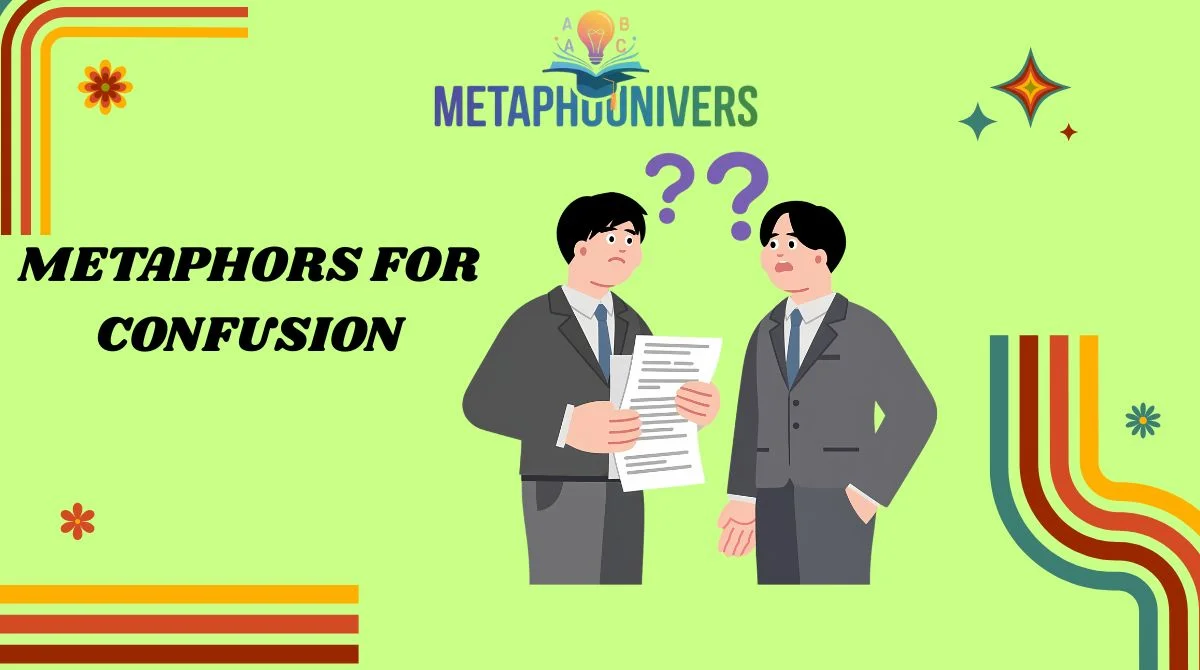
When it comes to confusion, metaphors become especially powerful because confusion itself is abstract, slippery, and difficult to articulate.
Using metaphors for confusion allows writers to transform a vague mental state into something vivid and tangible. Instead of simply saying “I was confused,” you can evoke disorientation, chaos, or uncertainty in a way that resonates deeply with readers.
These expressions do more than decorate writing—they reveal inner landscapes, psychological tension, and emotional depth.
Confusion often carries symbolic weight: it can represent transition, growth, fear, or even creativity in its rawest form.
By exploring metaphors around confusion, writers gain tools to express complexity, ambiguity, and the beauty hidden within not knowing.
Understanding the Symbolism of Confusion
Confusion is more than a lack of clarity—it is an emotional and psychological state with rich symbolic layers.
Emotional meaning
Confusion often signals vulnerability. It may arise from uncertainty, overwhelm, or conflicting desires. At times, it reflects curiosity—the mind stretching beyond its limits.
Psychological associations
It is linked with cognitive overload, indecision, and moments of transformation. Confusion frequently appears at turning points, when old beliefs collapse and new understanding has yet to form.
Cultural symbolism
Across cultures, confusion is often depicted as fog, darkness, or tangled paths—symbols of journeys where direction is unclear. It can represent both danger and discovery.
Literary usage
Writers use confusion to build tension, reveal character depth, or mirror chaotic environments. It often marks the beginning of insight, making it a powerful narrative device.
20 Unique Metaphors for Confusion
Nature-Based Metaphors
A Mind Lost in a Dense Forest
Meaning & Interpretation
Thoughts feel surrounded, with no clear path forward.
Best Used In
Storytelling, reflective essays
Example Sentence
His thoughts wandered like a traveler lost in a dense forest, every direction equally uncertain.
Why It Works
Forests symbolize complexity and hidden paths, mirroring mental disorientation.
A Compass Spinning Without North
Meaning & Interpretation
A loss of direction or guiding principle.
Best Used In
Speeches, philosophical writing
Example Sentence
Without answers, her mind became a compass spinning without north.
Why It Works
It evokes instability and the absence of guidance.
Fog Rolling Over a Quiet Harbor
Meaning & Interpretation
Clarity obscured gradually, not suddenly.
Best Used In
Poetry, descriptive prose
Example Sentence
Confusion rolled in like fog over a quiet harbor, swallowing certainty.
Why It Works
Fog conveys softness and uncertainty at once.
A River Splitting into Endless Streams
Meaning & Interpretation
Too many choices or thoughts branching out.
Best Used In
Essays, narratives
Example Sentence
Her mind split like a river into endless streams of doubt.
Why It Works
Flowing water reflects movement without resolution.
Emotional Metaphors
A Heart Pulling in Opposite Directions
Meaning & Interpretation
Conflicting emotions causing inner turmoil.
Best Used In
Romantic writing, drama
Example Sentence
His heart pulled in opposite directions, leaving him stranded in indecision.
Why It Works
It captures emotional tension vividly.
A Puzzle Missing Its Center Piece
Meaning & Interpretation
Something essential is absent.
Best Used In
Essays, storytelling
Example Sentence
Everything made sense except for one piece—like a puzzle missing its center.
Why It Works
It reflects incompleteness and frustration.
A Song Played Out of Tune
Meaning & Interpretation
Things feel slightly off, not entirely wrong.
Best Used In
Creative writing, speeches
Example Sentence
The situation felt like a song played out of tune—recognizable yet unsettling.
Why It Works
Music imagery connects emotionally with readers.
Dark & Intense Metaphors
A Maze with Moving Walls
Meaning & Interpretation
Constantly shifting uncertainty.
Best Used In
Thrillers, intense narratives
Example Sentence
Every answer led him deeper into a maze with moving walls.
Why It Works
It creates tension and instability.
A Storm of Voices in the Mind
Meaning & Interpretation
Overwhelming thoughts clashing at once.
Best Used In
Psychological writing
Example Sentence
Her mind roared with a storm of voices, none louder than the others.
Why It Works
Storm imagery amplifies chaos.
Walking on Shattered Glass Blindfolded
Meaning & Interpretation
Danger combined with uncertainty.
Best Used In
Dramatic storytelling
Example Sentence
He moved forward like someone walking on shattered glass blindfolded.
Why It Works
It conveys risk and confusion simultaneously.
Hopeful & Positive Metaphors
A Sunrise Struggling Through Clouds
Meaning & Interpretation
Clarity slowly emerging.
Best Used In
Inspirational writing
Example Sentence
Understanding came like a sunrise struggling through clouds.
Why It Works
It suggests hope within confusion.
A Seed Unsure Which Way to Grow
Meaning & Interpretation
Uncertainty as part of growth.
Best Used In
Personal essays
Example Sentence
She felt like a seed unsure which way to grow, yet full of possibility.
Why It Works
Growth imagery reframes confusion positively.
A Door Half Open in the Dark
Meaning & Interpretation
Partial understanding.
Best Used In
Narratives, speeches
Example Sentence
The truth stood like a door half open in the dark.
Why It Works
It balances mystery with hope.
Poetic & Romantic Metaphors
A Dance Without Rhythm
Meaning & Interpretation
Disconnection and imbalance.
Best Used In
Poetry
Example Sentence
Their thoughts moved like a dance without rhythm.
Why It Works
It blends elegance with disorder.
Ink Spilling Across an Unwritten Page
Meaning & Interpretation
Ideas scattered without form.
Best Used In
Creative writing
Example Sentence
Her thoughts spilled like ink across an unwritten page.
Why It Works
It creates visual and emotional imagery.
A Dream That Forgets Its Ending
Meaning & Interpretation
Lack of resolution.
Best Used In
Poetry, fiction
Example Sentence
The moment felt like a dream that forgot its ending.
Why It Works
Dreams naturally mirror confusion.
Dramatic & Powerful Metaphors
A Ship Without a Captain
Meaning & Interpretation
Lack of control or leadership in thought.
Best Used In
Speeches, narratives
Example Sentence
His mind drifted like a ship without a captain.
Why It Works
It conveys vulnerability and aimlessness.
A Broken Mirror Reflecting Too Many Angles
Meaning & Interpretation
Fragmented perception.
Best Used In
Literary writing
Example Sentence
Reality fractured like a broken mirror reflecting too many angles.
Why It Works
It shows distortion and multiplicity.
A Clock Ticking Without Time
Meaning & Interpretation
Motion without meaning.
Best Used In
Philosophical writing
Example Sentence
Everything moved, yet nothing made sense—like a clock ticking without time.
Why It Works
It creates existential depth.
How Writers Use These Metaphors
In novels
They reveal internal conflict and deepen character psychology.
In poetry
They turn abstract confusion into sensory experience.
In speeches
They help audiences relate to uncertainty and complexity.
In descriptive essays
They add richness, making ideas memorable and engaging.
Common Mistakes When Creating Metaphors
Cliché imagery
Overused comparisons weaken originality.
Mixed metaphors
Combining unrelated images confuses the reader further.
Overcomplication
Too many layers can obscure meaning.
Repetition patterns
Using similar imagery repeatedly reduces impact.
Practice Exercise
Fill in the blanks
- My thoughts felt like a ______ without a map.
- Confusion wrapped around me like ______.
- His explanation was a ______ missing its key.
- My mind drifted like ______ in the wind.
- The situation became a ______ with no exit.
- Her ideas tangled like ______.
- Understanding slipped away like ______.
- It felt like walking through ______ at night.
- My thoughts echoed like ______.
- The truth hid behind ______.
Create your own metaphors
- Describe confusion using weather imagery
- Compare confusion to a machine
- Create a metaphor using light and shadow
- Use an ocean-based image
- Turn confusion into a character
FAQs
What is a metaphor for confusion?
A metaphor for confusion is a figurative comparison that expresses mental uncertainty through vivid imagery, such as fog, mazes, or storms.
Why are metaphors effective in describing confusion?
They translate abstract mental states into sensory experiences, making them easier to understand and feel.
Can confusion be portrayed positively in metaphors?
Yes, it can symbolize growth, discovery, and the beginning of clarity.
How do I create original metaphors?
Focus on unique imagery, avoid clichés, and connect emotions with physical experiences.
Are metaphors important in creative writing?
They are essential tools that enhance depth, emotion, and memorability.
Conclusion
Confusion, though often uncomfortable, is one of the richest emotional states a writer can explore.
Through metaphor, it transforms from a vague mental haze into something textured, alive, and deeply human. Whether you depict it as a storm, a maze, or a quiet fog, each metaphor offers a new lens on uncertainty.
The key is experimentation—allow your imagination to wander, combine unexpected ideas, and trust your creative instincts.
In doing so, confusion itself becomes a source of clarity, guiding your writing toward originality and expressive power.

I am David Cooper, an English language enthusiast and content creator at Metaphounivers, dedicated to simplifying grammar and vocabulary for learners worldwide. I help students build confidence and improve their communication skills through clear, practical lessons.