Metaphors are the hidden architecture of language. They allow writers to translate emotion into image, turning invisible feelings into tangible experiences.
Rather than saying “I was disappointed,” a metaphor lets you say “My hopes folded like a paper crane in the rain.” Instantly, the emotion becomes vivid, sensory, and memorable.
When exploring metaphors for disappointment, we’re not just describing sadness — we’re mapping expectation against reality.
Disappointment lives in the space between what we imagined and what actually happened.
That tension makes it one of the most powerful emotional tools in storytelling, poetry, speeches, and reflective essays.
Symbolically, disappointment often represents collapse, deflation, fading light, or interrupted journeys. Emotionally, it reveals vulnerability.
Psychologically, it exposes attachment. A well-crafted metaphor captures that fracture without stating it directly — and in doing so, it resonates more deeply than literal language ever could.
Let’s explore how to transform disappointment into unforgettable imagery.
Understanding the Symbolism of Disappointment
Emotional Meaning
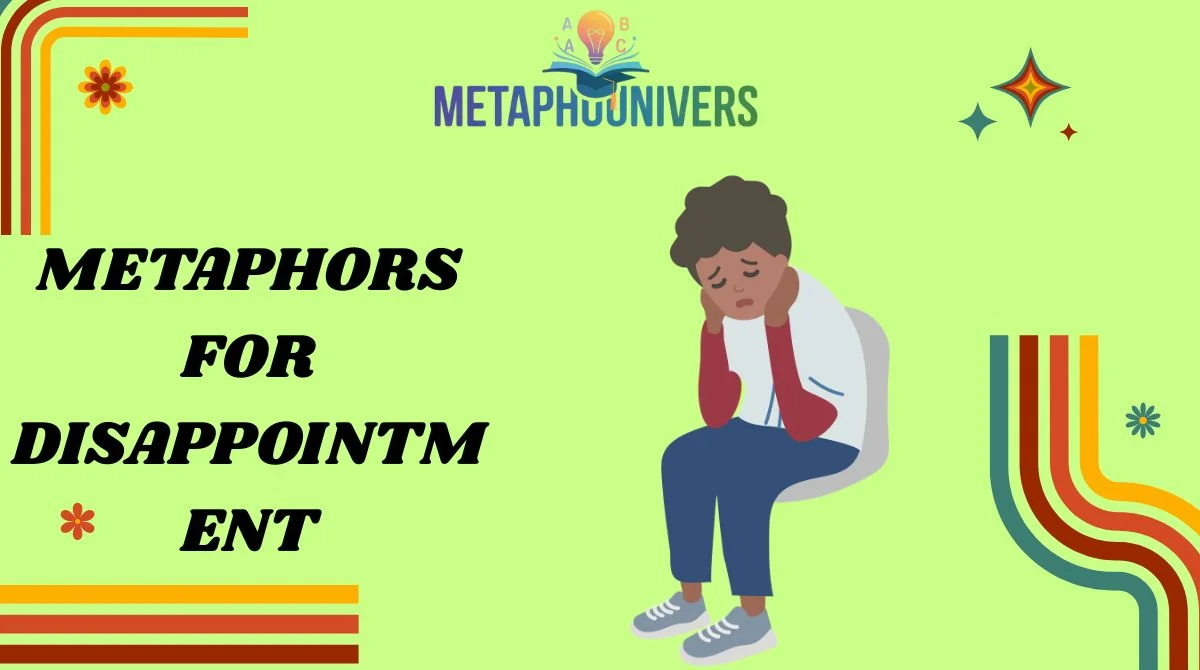
Disappointment is not explosive like anger or paralyzing like fear. It is quieter — a sinking, a dimming, a soft undoing. It often carries traces of hope within it, because without hope there is no disappointment.
Psychological Associations
From a psychological lens, disappointment signals expectation mismatch. It can challenge identity, confidence, or trust. Writers use it to show character depth — revealing what someone valued enough to feel let down.
Cultural Symbolism
Across cultures, disappointment is symbolized by fading light, broken objects, wilting plants, empty hands, or unfinished paths. These symbols transcend language, making them universally relatable.
Literary Usage
In literature, disappointment often marks a turning point:
- The failed dream
- The unreturned love
- The lost opportunity
It humanizes characters and invites empathy.
Nature-Based Metaphors
A Balloon Losing Air
Meaning & Interpretation: Hopes that slowly deflate rather than burst.
Best Used In: Personal essays, coming-of-age stories
Example Sentence: When the results were announced, my excitement became a balloon losing air in a quiet room.
Why It Works: The gradual deflation mirrors how disappointment drains energy.
A Sunset That Never Turned Golden
Meaning & Interpretation: Anticipation that fades before reaching beauty.
Best Used In: Poetry, reflective prose
Example Sentence: The promise of promotion was a sunset that never turned golden.
Why It Works: Sunsets symbolize closure; denying the glow emphasizes unmet expectation.
A Garden That Refused to Bloom
Meaning & Interpretation: Effort without reward.
Best Used In: Motivational writing, speeches
Example Sentence: Months of preparation became a garden that refused to bloom.
Why It Works: Gardening implies patience and care — heightening emotional investment.
Footprints Washed Away by the Tide
Meaning & Interpretation: Achievements erased or unnoticed.
Best Used In: Literary fiction
Example Sentence: My contribution felt like footprints washed away by the tide.
Why It Works: The ocean’s indifference underscores emotional isolation.
A Cloud That Promised Rain but Passed
Meaning & Interpretation: Anticipation without fulfillment.
Best Used In: Short stories
Example Sentence: His apology was a cloud that promised rain but passed.
Why It Works: Rain symbolizes relief; withholding it intensifies the letdown.
Emotional Metaphors
An Echo in an Empty Hall
Meaning & Interpretation: Effort met with silence.
Best Used In: Speeches, drama
Example Sentence: My congratulations felt like an echo in an empty hall.
Why It Works: Emphasizes emotional loneliness.
A Door That Opened to a Brick Wall
Meaning & Interpretation: Opportunity that leads nowhere.
Best Used In: Fiction, memoir
Example Sentence: The job offer was a door that opened to a brick wall.
Why It Works: Subverts expectation visually and instantly.
A Promise Written in Pencil
Meaning & Interpretation: Fragile commitment.
Best Used In: Poetry
Example Sentence: His loyalty was a promise written in pencil.
Why It Works: Pencil marks erase easily — symbolic of instability.
Applause That Never Came
Meaning & Interpretation: Recognition denied.
Best Used In: Dramatic monologues
Example Sentence: I bowed to applause that never came.
Why It Works: Performance imagery reflects vulnerability.
A Song Missing Its Final Note
Meaning & Interpretation: Incomplete resolution.
Best Used In: Literary essays
Example Sentence: The evening ended like a song missing its final note.
Why It Works: Music without closure leaves emotional tension.
Dark & Intense Metaphors
A Bridge That Collapsed Midway
Meaning & Interpretation: Trust broken suddenly.
Best Used In: High-stakes storytelling
Example Sentence: Our partnership was a bridge that collapsed midway.
Why It Works: Bridges symbolize connection — collapse equals rupture.
Ash Where Fire Once Lived
Meaning & Interpretation: Passion extinguished.
Best Used In: Romantic poetry
Example Sentence: My ambition turned to ash where fire once lived.
Why It Works: Fire imagery captures former intensity.
A Mirror That Refused Reflection
Meaning & Interpretation: Loss of validation or identity.
Best Used In: Psychological fiction
Example Sentence: Her praise was a mirror that refused reflection.
Why It Works: Mirrors symbolize affirmation.
A Train That Never Arrived
Meaning & Interpretation: Long-awaited chance that fails.
Best Used In: Narrative prose
Example Sentence: Opportunity was a train that never arrived.
Why It Works: Travel implies forward motion; absence creates stagnation.
A Crown Made of Paper
Meaning & Interpretation: False achievement.
Best Used In: Satire
Example Sentence: The award felt like a crown made of paper.
Why It Works: Royal imagery contrasts with fragility.
Hopeful & Transformative Metaphors
A Detour on the Road
Meaning & Interpretation: Temporary setback.
Best Used In: Motivational content
Example Sentence: The rejection was only a detour on the road.
Why It Works: Keeps forward momentum intact.
Seeds Waiting Underground
Meaning & Interpretation: Delayed success.
Best Used In: Inspirational speeches
Example Sentence: My efforts were seeds waiting underground.
Why It Works: Suggests hidden growth.
A Draft Before the Masterpiece
Meaning & Interpretation: Imperfect beginning.
Best Used In: Creative workshops
Example Sentence: That failure was just a draft before the masterpiece.
Why It Works: Frames disappointment as process.
Clouds Before a Clear Sky
Meaning & Interpretation: Temporary obscurity.
Best Used In: Personal growth essays
Example Sentence: This setback is only clouds before a clear sky.
Why It Works: Universal weather cycle symbolizes resilience.
A Lesson Wrapped in Silence
Meaning & Interpretation: Hidden wisdom within letdown.
Best Used In: Reflective writing
Example Sentence: The missed chance was a lesson wrapped in silence.
Why It Works: Encourages interpretation beyond pain.
How Writers Use These Metaphors
In novels: To deepen character vulnerability and create emotional turning points.
In poetry: To compress complex feeling into a single, striking image.
In speeches: To build empathy and inspire perseverance.
In descriptive essays: To transform personal experience into shared imagery.
Common Mistakes When Creating Metaphors
- Leaning on overused imagery like “broken heart”
- Mixing metaphors (e.g., “a sinking ship on a broken road”)
- Making imagery too abstract
- Repeating similar environmental themes excessively
- Explaining the metaphor too much
Strong metaphors trust the reader.
Practice Exercise
Fill in the Blanks
- My excitement became a __________ in the wind.
- The promise felt like __________ without ink.
- His encouragement was a __________ that led nowhere.
- The silence grew like __________ after a storm.
- My ambition sat like __________ on the shelf.
- The opportunity slipped away like __________.
- Her smile faded like __________ at dusk.
- The award felt like __________ in my hands.
- Hope dissolved like __________ in water.
- The meeting ended like __________ without a key.
Create Your Own Metaphor
- Describe disappointment using a natural disaster image.
- Compare disappointment to a household object.
- Write a hopeful metaphor for academic failure.
- Craft a metaphor involving light and shadow.
- Create one metaphor using sound imagery.
FAQs
What makes a metaphor for disappointment powerful?
Specific imagery tied to emotional stakes makes it memorable and relatable.
Are nature metaphors better than emotional ones?
Neither is superior — effectiveness depends on tone and audience.
Can metaphors for disappointment be positive?
Yes. Transformative metaphors reframe setbacks as growth.
How do I avoid clichés when writing metaphors?
Focus on unique comparisons drawn from personal observation.
Should metaphors be explained in writing?
Rarely. Let context reveal meaning instead of over-explaining.
Conclusion
Disappointment is not merely a feeling — it is a narrative pivot. Through metaphor, writers transform it from a flat statement into living imagery.
Whether you choose collapsing bridges, silent halls, or seeds beneath soil, your task is the same: make the unseen visible.
The most effective metaphors don’t just describe disappointment — they illuminate it.
Write boldly. Compare unexpectedly. And let your imagery carry what plain words cannot.

I am David Cooper, an English language enthusiast and content creator at Metaphounivers, dedicated to simplifying grammar and vocabulary for learners worldwide. I help students build confidence and improve their communication skills through clear, practical lessons.